Match the Technique to Your Symptom, Not Just the Label "Anxiety"
Anxiety is not one experience. It is a cluster of symptoms that feel completely different depending on the person and the moment. Racing thoughts at 2 a.m. feel nothing like the chest tightness before a presentation, and neither feels like the sudden wave of panic in a crowded store. The relaxation technique that works for one of these can be useless - or even harmful - for another.
The single most important thing I have learned from years of working with anxious clients is this: match the technique to the symptom. Racing thoughts need cognitive techniques. Physical tension needs somatic techniques. Acute panic needs physiological resets. When you pick the right tool for the right job, relaxation is not just possible - it is predictable.
Here is the framework this article is built around. Identify your dominant symptom cluster, then choose from the techniques below that are proven to address that specific cluster. I will also tell you what to avoid for each type, because sometimes the most popular advice is exactly the wrong advice.
Why Most Relaxation Advice Fails
Most relaxation advice treats anxiety as a single condition. "Try deep breathing" is offered as if it works for everyone, in every moment. But anyone who has tried to deep-breathe their way through a panic attack knows the truth: it can make things worse. When you hyperventilate during a panic attack, taking deeper, slower breaths can actually increase the feeling of suffocation because you are already over-breathing.
When I first started practicing relaxation techniques myself, I made this exact mistake. I was in the middle of a panic attack on a subway platform, and I tried to do slow, deep breathing. Within minutes, I was lightheaded and my hands were tingling - classic hyperventilation symptoms. What I needed was not slow breathing but a physiological reset that would engage my vagus nerve quickly and safely.
The thing nobody tells you about relaxation techniques is that they are not interchangeable. They work through different mechanisms, on different parts of the nervous system, and at different speeds. A grounding technique that is perfect for a racing mind does nothing for a locked-up jaw and shoulders. A cold-water splash that snaps you out of a panic spiral is overkill for general daily stress.
That is why this guide is organized by symptom cluster, not by technique popularity.
What Is Actually Happening in Your Nervous System
Before we get to the techniques, you need a 60-second primer on the physiology. Anxiety is regulated by the autonomic nervous system, which has two branches: the sympathetic (fight-or-flight) and the parasympathetic (rest-and-digest). When you feel anxious, your sympathetic branch is dominant. Your heart rate increases, your pupils dilate, and cortisol and adrenaline circulate through your bloodstream.
Relaxation techniques work by activating the parasympathetic branch, specifically through the vagus nerve. This is the primary nerve of the parasympathetic system. It runs from your brainstem down to your abdomen, and it slows your heart rate, lowers blood pressure, and signals to your body that it is safe to relax.
Different techniques activate the vagus nerve through different pathways. Somatic techniques like progressive muscle relaxation work from the body up, using muscle tension and release to trigger the relaxation response. Cognitive techniques work from the mind down, using attention and perception to shift your brain's threat assessment. Physiological resets like cold water work directly on the vagus nerve through the mammalian dive reflex.
Understanding this matters because it explains why matching matters. A mental technique cannot relax a muscle that is already clenched. A physical technique cannot quiet a mind that is already spiraling. You need to target the system that is actually dysregulated.
Racing Thoughts? Use Cognitive Reset Techniques
If your anxiety shows up as a relentless stream of thoughts - replaying conversations, catastrophizing about the future, or spiraling from one worry to the next - you need techniques that interrupt the thought loop and ground you in the present moment.
The 5-4-3-2-1 Grounding Method
This is the most effective cognitive reset I know. It forces your brain to shift from abstract, future-oriented worry to concrete, present-moment sensory input. Here is how it works:
- Name 5 things you can see around you right now.
- Name 4 things you can physically feel (the chair under you, the air on your skin).
- Name 3 things you can hear (a fan, traffic, your own breath).
- Name 2 things you can smell (or 2 smells you like, if you cannot smell anything).
- Name 1 thing you can taste (or 1 taste you enjoy).
The reason this works is that sensory processing and worry processing compete for the same cognitive resources. When you force your brain to catalog sensory details, it literally has less bandwidth for catastrophic thinking. It is not a distraction - it is a targeted cognitive intervention.
One practical tip: do not rush through it. The technique fails when people race through all five steps in ten seconds. Take at least 20 seconds per step. The goal is to keep your brain occupied long enough for the worry loop to lose its grip.
Cognitive Defusion: Distance Yourself from the Thought
Cognitive defusion comes from Acceptance and Commitment Therapy (ACT). The idea is that you are not your thoughts. A thought is an event that happens in your mind, not a fact that you must respond to.
A simple defusion exercise: when a worry thought appears, say "I notice I am having the thought that..." and then repeat the worry back to yourself. For example, "I notice I am having the thought that I will fail the presentation tomorrow." This small linguistic shift creates distance between you and the thought.
Most people don't realize that the goal is not to eliminate the thought. The goal is to change your relationship to it. When you stop fighting the thought, it loses its power. This is counterintuitive but clinically well-supported. The American Psychological Association notes that acceptance-based approaches can be as effective as traditional cognitive restructuring for some anxiety presentations.
Guided Imagery - Done Right
Guided imagery is often recommended for anxiety, but it fails when people choose the wrong imagery. Telling someone with a fear of flying to imagine floating on a cloud is not helpful. The imagery needs to be personally meaningful and tied to a memory of safety.
Here is the version that works: close your eyes and recall a specific place where you felt completely safe and calm. It can be a childhood home, a beach, a grandparent's kitchen. Now engage every sense. What did the light look like? What sounds were present? What did the air smell like? What did the ground feel like under your feet?
The key is specificity. "Imagine a peaceful place" is too vague. "Remember the exact sound of the screen door at your grandmother's house on a summer evening" is specific enough to trigger an actual physiological response. Your brain cannot tell the difference between a vividly recalled memory and a present experience, so it starts to relax.
What to Avoid for Racing Thoughts
- Avoid meditation apps that emphasize "clearing your mind." This sets you up for failure. The goal is not to stop thoughts - it is to change your relationship to them.
- Avoid journaling about your worries for more than 10 minutes. Ruminative writing can reinforce the worry loop. If you journal, end with a concrete next action step.
- Avoid caffeine and stimulants during high-anxiety periods. They amplify the sympathetic nervous system and make cognitive techniques significantly less effective.
Physical Tension? Use Somatic Techniques
If your anxiety lives in your body - tight shoulders, clenched jaw, knotted stomach, shallow breathing - you need techniques that work from the body up. Mental techniques will not release a muscle that has been clenched for hours.
Progressive Muscle Relaxation (PMR)
PMR was developed by Edmund Jacobson in the 1920s, and it remains one of the most effective somatic relaxation techniques. The principle is simple: by deliberately tensing and then releasing each muscle group, you create a sharp contrast that allows the body to recognize what relaxation actually feels like.
Here is the sequence I use with clients. Start with your hands: clench both fists as hard as you can for 5 seconds, then release and notice the sensation of release for 15 seconds. Move to your arms: bend your elbows and tense your biceps for 5 seconds, release. Then shoulders, jaw, eyes, chest, stomach, thighs, calves, and feet.
Work through each group in order, and do not skip the "notice the release" part. That 15-second window is where the learning happens. Your brain is mapping the difference between tension and relaxation, and that map becomes stronger with each repetition.
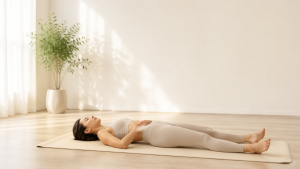
A complete PMR session takes 15 to 20 minutes. I recommend doing it lying down, not sitting. And here is the honest limitation: PMR is not great for acute panic. It takes too long to work through the sequence. It is a daily practice technique, not an emergency tool.
Body Scan Meditation
A body scan is similar to PMR but without the tension component. You simply move your attention through your body, noticing sensations without trying to change them. This is harder than it sounds, and it is also more powerful than it sounds.
The trick is to notice without judging. When you notice tightness in your jaw, do not try to relax it. Just notice it. The paradox is that the moment you stop trying to force relaxation, the body often releases on its own. This is the "letting go" mechanism, and it is the opposite of the "trying harder" approach that most anxious people default to.
Start at the top of your head and work down to your toes. Spend at least 30 seconds on each body region. If you notice a region that is particularly tight, stay there for an extra minute. The research from the National Center for Complementary and Integrative Health shows that body scan meditation can reduce stress-related physiological markers, but consistency matters more than session length.
Restorative Yoga and Gentle Stretching
Not all yoga helps with anxiety. Vigorous vinyasa or hot yoga can actually increase sympathetic activation because it raises heart rate and body temperature. Restorative yoga, on the other hand, uses supported poses held for 3 to 5 minutes each, which activates the parasympathetic system.
If you cannot attend a class, the two poses I recommend most are legs-up-the-wall (lie on your back with your legs resting up against a wall) and child's pose. Hold each for at least 3 minutes. The long hold time is what makes the difference. A 30-second stretch is not enough to shift your nervous system.
What to Avoid for Physical Tension
- Avoid high-intensity exercise for anxiety relief. It can spike cortisol temporarily. Moderate exercise like walking or swimming is better for anxious tension.
- Avoid massage tools that target only one area. Tension patterns are systemic. Releasing your shoulders while your jaw stays clenched does not produce a full relaxation response.
- Avoid alcohol as a muscle relaxant. It works in the short term but disrupts sleep architecture and increases rebound anxiety the next day.
Acute Panic? Use Physiological Resets
When panic hits, it comes on fast. Your heart races, your chest tightens, you feel like you cannot breathe, and you may feel dizzy or detached from reality. This is not the time for a 20-minute body scan or a grounding technique that requires focused attention. You need something that works in under 60 seconds.
Cold Water and the Mammalian Dive Reflex
The most underrated panic intervention is cold water. When cold water hits your face, it triggers the mammalian dive reflex, which is a hardwired physiological response that slows your heart rate and redirects blood flow to your core. It is one of the fastest ways to activate the vagus nerve.
Here is how to do it: fill a sink with cold water (as cold as you can tolerate, but not painful). Hold your breath and submerge your face for 10 to 15 seconds. If you cannot submerge your face, splash cold water on your face repeatedly or hold an ice cube against your cheeks and forehead.
I have seen this stop a full-blown panic attack in under a minute. It is not a comfortable experience, and it should not be. The discomfort is the point - it forces your nervous system to switch priorities from panic to physical survival, and that switch is what breaks the panic cycle.
Breath Ratios That Actually Help (and the Ones That Don't)
Deep breathing is the most recommended relaxation technique, and it is also the most misapplied. The problem is that during a panic attack, you are often already over-breathing. Taking slow, deep breaths on top of that can lower your blood CO2 levels and make you feel more lightheaded, which triggers more panic.
The breath pattern that works for acute panic is one that extends the exhale relative to the inhale. A specific ratio I use is the 4-7-8 pattern: inhale through your nose for 4 counts, hold for 7 counts, exhale through your mouth for 8 counts. The extended exhale activates the vagus nerve and stimulates the baroreflex, which helps lower heart rate.
But here is the critical detail: the hold should not feel like a struggle. If you cannot hold for 7, reduce it to 5. The pattern matters more than the exact counts. What you are doing is deliberately slowing your exhale to trigger the parasympathetic response.
I want to be honest about the limitation here. Breathing techniques do not work for everyone during a panic attack. In some cases, focusing on your breath can make you more aware of your breathing and increase the sense of suffocation. If that happens to you, skip the breathing and go straight to cold water or physical movement.
What to Avoid for Acute Panic
- Avoid rapid, shallow breathing exercises that emphasize force. They can trigger or worsen hyperventilation.
- Avoid closing your eyes and sitting still if you are feeling detached or dizzy. Movement - even just walking in circles - can help ground you in your body.
- Avoid going to a quiet, dark room. This can reinforce the association between panic and isolation. Stay in a lit, ventilated space.
Troubleshooting: When Relaxation Backfires
No technique works for everyone, and some techniques can make anxiety worse for certain people. Here are the most common problems I see, and how to handle them.
Deep breathing triggers hyperventilation. As I mentioned above, slow breathing can be counterproductive if you are already over-breathing. The fix is to focus on the exhale and avoid making the inhale deep. Or switch to a different technique entirely, like cold water or grounding.
Meditation makes you more anxious. This is more common than people admit. When you sit quietly and turn your attention inward, you may notice anxious thoughts that you were previously distracting yourself from. This is called "relaxation-induced anxiety," and it affects a significant minority of people. If this is you, do not force meditation. Use active techniques like walking or body-based approaches instead.
Grounding makes you feel worse. Some people find that sensory grounding increases their awareness of uncomfortable physical sensations, like a racing heart or sweaty palms. If the 5-4-3-2-1 method makes you more anxious, try a cognitive defusion technique instead, or use a physical reset like cold water.
You feel the urge to "do it perfectly." Perfectionism is a common trait in people with anxiety, and it can turn relaxation into another performance. If you catch yourself monitoring your heart rate or judging whether you are "relaxed enough," you are doing the opposite of relaxing. The fix is to lower the bar. Even 30 seconds of a technique, done imperfectly, is better than not doing it at all.
Building Your Personal Relaxation Toolkit
You do not need to master every technique in this article. You need a small set of techniques that you can deploy depending on the situation. Here is a simple framework for building your toolkit.
Pick one technique from each category. One cognitive technique for racing thoughts, one somatic technique for physical tension, and one physiological reset for acute panic. Practice each one for at least 5 minutes per day, ideally when you are not anxious. The reason is that techniques work best when they are already familiar. You do not want to be learning a new technique in the middle of a panic attack.
Here is a sample toolkit to get you started:
- Racing thoughts: 5-4-3-2-1 grounding (2 minutes)
- Physical tension: Progressive muscle relaxation (15 minutes, daily)
- Acute panic: Cold water face immersion (30 seconds)
- General daily stress: 4-7-8 breathing (3 rounds, twice a day)
The most important principle is consistency. A daily 5-minute practice of one technique is more effective than a 45-minute session once a month. The nervous system learns through repetition, and the more you practice activating your parasympathetic system, the faster it responds when you need it.
Also, track what works. Keep a simple note on your phone: date, situation, technique used, and effectiveness on a scale of 1 to 10. After two weeks, you will see patterns. You will know which techniques work best for you, in which situations, and you can adjust your toolkit accordingly.
When to Seek Professional Help
Relaxation techniques are a first-line tool, not a replacement for professional care. If your anxiety is interfering with your work, relationships, or daily functioning, or if you are experiencing panic attacks more than once a week, please talk to a mental health professional.
According to the National Institute of Mental Health, anxiety disorders are the most common mental health condition in the United States, affecting over 19% of adults in a given year. They are also highly treatable. Cognitive behavioral therapy, exposure therapy, and in some cases medication are evidence-based treatments that work.
Relaxation techniques are a complement to professional treatment, not a substitute. They are the tools you use in the moment to manage symptoms. A therapist is the person who helps you understand the underlying patterns and build a long-term strategy.
The Bottom Line
Anxiety is not a single experience, and relaxation is not a single technique. Match the technique to your symptom cluster, and you will see results that a generic "just breathe" approach will never deliver.
Racing thoughts need cognitive resets like grounding and defusion. Physical tension needs somatic approaches like PMR and body scans. Acute panic needs fast physiological resets like cold water and extended-exhale breathing. And when a technique does not work, that is information, not failure. Adjust, try something else, and keep building your toolkit.
You already have everything you need to start. Pick one technique from the list that matches your most common symptom, practice it today, and notice what happens. That is the first step.