Why "Fall Asleep Fast" Is Different from "Sleep Better"
If you want to fall asleep fast, stop looking for a single silver bullet. The fastest sleepers I've ever worked with all do the same two things: they wind down on a strict schedule, and they use a specific mental technique when they hit the pillow. The first part is the 3-3-3 rule or the 10-3-2-1-0 method. The second part is something like the military method or 4-7-8 breathing. Combine both, and you can cut your sleep onset time from 45 minutes to under 10.
Most sleep advice on the internet is about sleep hygiene: consistent schedules, cool rooms, no screens. That's all helpful, but none of it is designed to make you fall asleep faster on any given night. Sleep hygiene improves your overall sleep quality. Rapid sleep onset requires a time-released wind-down that lowers your arousal level in stages, plus an in-the-moment technique that shuts off the mental chatter. This article is about the second kind of advice.
The key metric is sleep onset latency (SOL) - how long it actually takes you to transition from fully awake to asleep. The average adult takes 10 to 20 minutes. If you're hitting 30 or 40, the problem isn't your mattress. It's your pre-bed routine.
The 3-3-3 Rule: A Time-Released Wind-Down
The 3-3-3 rule is a simple framework for structuring your last three hours before bed. It answers the question "What can I do before bed to fall asleep faster?" by telling you exactly when to cut things off.
Here's what the 3-3-3 rule for sleep means in practice:
- 3 hours before bed: No more food or alcohol.
- 2 hours before bed: No more work.
- 1 hour before bed: No more screens.
When I first tried the 3-3-3 rule, I made the mistake of thinking a small protein bar at 9pm was fine. It wasn't. Even a light snack triggers insulin and raises your core body temperature slightly. Your body needs to drop its core temperature by about 1 degree Fahrenheit to initiate sleep, and digestion works against that. The same goes for alcohol - it might make you drowsy initially, but as your liver metabolizes it, the rebound effect causes fragmented sleep and early awakening. According to the National Institute on Alcohol Abuse and Alcoholism, alcohol disrupts REM sleep and increases sleep latency later in the night.
The 2-hour work cutoff is the one most people resist. I get it. But "work" also includes checking email, reading Slack messages, or mentally planning tomorrow's to-do list. The goal is to stop tasks that keep your executive function online. If you absolutely must think about work, write it down in a notebook and close the notebook. That physical act of outsourcing your brain is surprisingly effective.
The 1-hour screen cutoff is the most well-known, but the 3-3-3 version adds a nuance: it's not just about blue light. It's about content. Scrolling Instagram or reading a tense news article activates your amygdala and keeps your sympathetic nervous system fired up. When I replaced my phone with a physical book (a boring one, not a thriller), my sleep onset time dropped from 30 minutes to about 12. The book's lack of plot was a feature, not a bug.
The 10-3-2-1-0 Method: The Harder-Core Version
If you're a caffeine addict or a chronic snooze-button user, the 10-3-2-1-0 method is your upgrade. It's the same idea as the 3-3-3 rule but with two additional dials: caffeine and the morning alarm.
Here's what the 10-3-2-1-0 rule for sleep actually says:
- 10 hours before bed: No more caffeine.
- 3 hours before bed: No more food or alcohol.
- 2 hours before bed: No more work.
- 1 hour before bed: No more screens.
- 0: Zero snooze button presses in the morning.
The 10-hour caffeine cutoff is based on caffeine's half-life. The FDA notes that caffeine has a half-life of about 5 to 6 hours in the average person. That means if you drink a 200mg coffee at 3pm, roughly 100mg is still active at 8pm, and 50mg at 1am. For sensitive people, even 30mg can delay sleep onset. Ten hours gives your body enough time to clear most of it.
The "0" at the end is the part that took me years to internalize. When I first adopted the 10-3-2-1-0 method, I set my alarm for 6:30 but woke up at 6:10 and hit snooze twice. That fragmented sleep in the final hour actually made me groggier than if I'd just gotten up. The snooze button teaches your brain that the alarm is a suggestion, not a signal. Breaking that habit meant setting a single alarm and physically placing my phone across the room. For the first week, I was miserable. By the end of week two, I was falling asleep faster at night because my body knew it had one chance to get good sleep.
Which rule should you choose? If you're under 30 and caffeine doesn't seem to affect you, the 3-3-3 rule is probably enough. If you're over 35, have a high-stress job, or find yourself staring at the ceiling at 1am, go with 10-3-2-1-0. The extra caffeine discipline and the snooze ban address the two most common hidden sources of sleep onset insomnia.
The Hour Before Bed: The Pre-Sleep Ritual
Once you've enforced the 3-3-3 or 10-3-2-1-0 boundaries, the hour before bed is where you actively prepare your body for rapid sleep onset. This is the time to do things that lower physiological arousal and signal to your brain that the day is over.
What can you do before bed to fall asleep faster? The most effective actions are:
- Take a warm bath or shower 30 to 60 minutes before bed. The warm water raises your core temperature, and the subsequent cooling triggers a sleep-promoting drop in body temperature. This is the same mechanism that makes a cool bedroom helpful.
- Do 5 minutes of gentle stretching or progressive muscle relaxation. Focus on your neck, shoulders, and jaw - the places where tension accumulates without you noticing.
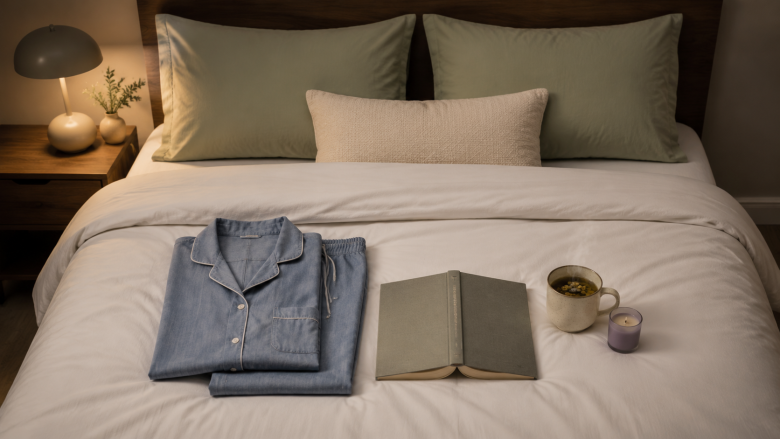
- Read a boring book on paper. Avoid anything with a gripping plot or emotional intensity. A dense history book or a technical manual works better than a novel.
- Write a "brain dump" list of everything on your mind, then close the notebook. This outsources your worries so your brain doesn't feel the need to keep them active.
- Listen to a sleep-specific audio track that uses binaural beats or a repetitive narration. The point is to give your mind a single, monotonous focus.
The thing nobody tells you about this hour is that it should be intentionally boring. Most people make the mistake of turning the pre-bed hour into "me time" filled with stimulating activities like playing video games, chatting with friends, or watching an exciting show. That's not winding down; that's switching tasks. Your brain interprets novelty and emotional engagement as reasons to stay alert. Boredom is the goal.
One edge case worth noting: if you're a busy working parent, the hour before bed often collides with kid duties. In that case, the 3-3-3 rule may be impossible. For a realistic approach that fits around children's bedtime, see our Bedtime Routine for Busy Working Parents guide. The principle stays the same, but the timing shifts.
Rapid-Onset Techniques: When You're In Bed and Can't Sleep
Even with a perfect pre-bed routine, there will be nights when your head hits the pillow and your brain starts replaying every conversation from the day. This is where rapid-onset techniques come in. These are in-the-moment mental and physical tricks that force your nervous system into a sleep state.
The Military Method
The military method was developed to help pilots fall asleep in two minutes, even under combat stress. It works best for people who hold tension in their body. Here's the process:
- Relax your face muscles, including your jaw, tongue, and around your eyes.
- Drop your shoulders as low as they'll go, then relax your upper arms and forearms.
- Exhale and relax your chest, then your legs, starting with your thighs and working down to your feet.
- Clear your mind for 10 seconds by imagining a calm scene, or repeating the phrase "don't think" over and over.
When I first tried the military method, I made the mistake of tensing my shoulders first before relaxing them. That's wrong. You need to go straight from normal to relaxed, not introduce extra tension. Also, if you're someone who is hyper-aware of your breathing, the phrase "don't think" can backfire. In that case, switch to visualizing a specific static image, like a black velvet curtain or a motionless lake.
4-7-8 Breathing
The 4-7-8 breathing technique is a simple pattern that activates your parasympathetic nervous system. Inhale through your nose for 4 seconds, hold for 7 seconds, exhale slowly for 8 seconds. Repeat four times.
The long exhale is what matters. A slower exhale triggers the vagal response and lowers your heart rate. I've found that 4-7-8 works best when you genuinely can't stop thinking, because the count gives your working memory something to do. For a deeper explanation of the physiology, see our article on How to Fall Asleep Faster with Breathing.
One limitation: if you have asthma or respiratory issues, holding your breath for 7 seconds can feel uncomfortable. Start with 4-4-4 (inhale, hold, exhale for 4 each) and work up gradually. The pattern matters more than the exact count.
The Cognitive Shuffle
The cognitive shuffle is the most effective technique I've found for people who can't stop planning or worrying at night. The idea is to randomly and rapidly name items in a category, but in a way that's boring enough to distract your brain from its usual rumination.
For example, think of a word like "apple." Then, for each letter, think of a word starting with that letter and picture it: A is for anchor, P is for piano, P is for puddle, L is for lamp, E is for envelope. The randomness prevents your brain from building a coherent thought chain. It forces your working memory to loop, which mimics the micro-sleep state just before you drift off.
I used to try to count sheep, but that's too repetitive and your brain will wander. The cognitive shuffle works because it's just unfamiliar enough to hold your attention without engaging your emotions. There are apps that do this for you, but a mental version works just as well.
Reverse Psychology (Paradoxical Intention)
This is the technique that sounds absurd but has real research behind it. Instead of trying to fall asleep, you try to stay awake. Keep your eyes open, tell yourself "I will not fall asleep," and let go of any effort to sleep.
Paradoxical intention works because sleep performance anxiety - the fear of not being able to sleep - is what keeps many people awake. When you remove the goal, the anxiety drops. In my experience, this works best for people who are "try-hards" and perfectionists. If you're the type who gets angry when you're still awake after 20 minutes, this is your technique.
One warning: don't use this if you're dangerously sleep-deprived and need to be alert the next day. Trying to stay awake can backfire if you're so exhausted that you'll fall asleep anyway, but the mental effort of keeping your eyes open may actually delay sleep longer than you'd like. Use it only when you notice the anxiety spiral.
Which Technique Should You Use? A Quick Decision Matrix
No single rapid-onset technique works for everyone. Here's the decision matrix I give to clients:
- If you hold tension in your body (clenched jaw, tight shoulders) - start with the military method.
- If your mind races with worries - use the cognitive shuffle or write a brain dump.
- If you feel physically restless or anxious - use 4-7-8 breathing.
- If you're frustrated that you can't sleep - try reverse psychology.
You can combine techniques. The military method relaxes your body, then the cognitive shuffle distracts your mind. But don't try more than two in one night. Jumping between techniques becomes another source of stimulation.
Common Mistakes That Sabotage Fast Sleep
After years of helping people shorten their sleep onset time, I've noticed the same mistakes coming up again and again. Here are the ones that undermine even the best bedtime routine.
Mistake 1: Going to bed hungry. The 3-3-3 rule says no food 3 hours before bed, but if you eat dinner at 6pm and go to bed at 11pm, you might be hungry. Hunger triggers cortisol, which keeps you awake. The fix is to eat a small, low-glycemic snack like a banana or a handful of almonds about 30 minutes before bed. That's not enough to spike your metabolism, but it's enough to keep your stomach from growling.
Mistake 2: Using alcohol as a sleep aid. A glass of wine might help you doze off, but the metabolism of alcohol produces acetaldehyde, which acts as a stimulant as it's broken down. You'll likely wake up after a few hours and struggle to get back to sleep. If you're using alcohol to fall asleep fast, you're borrowing from your sleep quality.
Mistake 3: Treating the "no screens" hour as a time for "active relaxation" like playing games or scrolling on a tablet. The type of screen matters less than the content. A video call with a friend is stimulating. A passive nature documentary is less so. But even a passive screen keeps your brain in a state of light vigilance. Give your eyes a rest from all screens, not just social media.
Mistake 4: Inconsistent wake times. The thing nobody tells you about sleep onset is that your body's sleep pressure builds based on when you wake up, not when you go to bed. If you wake up at 6am on weekdays and 10am on weekends, your body's circadian rhythm gets confused. On Sunday night, you won't have enough sleep pressure to fall asleep fast. Consistent wake time, even on weekends, is the single most underrated factor in rapid sleep onset.
Adapting the Routine for Shift Work, Parents, and Night Owls
The 3-3-3 and 10-3-2-1-0 rules assume a standard daytime schedule. If you work nights, have young kids, or are a natural night owl, you need to adapt them - but the principles stay the same.
Shift workers: The rules should be relative to your sleep window, not to the clock. If you go to bed at 8am after a night shift, then no food at 5am, no work at 6am, no screens at 7am. The caffeine cutoff becomes 10 hours before 8am, which is 10pm the night before. That can be tricky, so shift workers often need a stricter version: commit to a 6-hour caffeine cutoff instead of 10. You'll still benefit, but you may need to rely more on the rapid-onset techniques.
Parents: You can't always control when your kids go to bed, so the "no work" boundary is often the first to break. If you're a parent, I recommend a shortened version: 90 minutes before bed, no work and no screens for the last 30 minutes. For a full plan that works around children's bedtimes, our Bedtime Routine for Busy Working Parents guide has the details.
Night owls: If you naturally fall asleep at 1am and wake at 9am, don't force a midnight bedtime just to follow the 3-3-3 rule. Instead, apply the rules relative to your actual bedtime. The goal is to shorten your sleep onset latency, not to conform to society's schedule. The one thing you must keep is a consistent wake time. Even night owls can fall asleep fast if their wake time is stable.
The Full Routine: A Time-Stamped Walkthrough
Here's what a complete bedtime routine to fall asleep fast looks like when you put everything together. I'll use a 10:30pm bedtime as an example, but you can shift the times to match your schedule.
- 12:30pm: Last caffeine (if using the 10-3-2-1-0 method). For 3-3-3, you can skip this.
- 7:30pm: Finish dinner. No more alcohol or food (except a tiny pre-bed snack if needed).
- 8:30pm: Stop work. No more emails, no more planning. If something urgent pops up, write it down.
- 9:00pm: Take a warm shower or bath.
- 9:30pm: Dim the lights. Do 5 minutes of gentle stretching or progressive muscle relaxation.
- 9:45pm: Read a boring book or do a brain dump journal. No screens.
- 10:15pm: Get into bed. If you're not sleepy yet, do one rapid-onset technique: military method, 4-7-8 breathing, cognitive shuffle, or reverse psychology.
- 10:30pm: Lights out.
This routine is not a magic pill. Some nights you'll still lie awake, and that's okay. The goal is to reduce the frequency and duration of those nights. When I first started using this exact structure, my average sleep onset time went from 35 minutes to around 8 minutes. But it took two weeks of consistency. Your brain is not an instant switch; it's a muscle that needs to learn a new pattern.
The fastest way to fall asleep fast is to stop searching for a miracle trick and start treating sleep like a training protocol. Use the 3-3-3 or 10-3-2-1-0 method to build the right conditions, then choose one rapid-onset technique to cross the finish line. That combination is the closest thing to a reliable, repeatable formula for falling asleep fast.