Your bedroom is not a showroom. It's a sensory environment that either prepares your nervous system for rest or keeps it scanning for threats. Most advice on relaxing bedroom layouts focuses on what you see: colors, furniture placement, decluttered shelves. That's half the story. The other half is what you hear, smell, feel, and even the temperature your skin registers. This guide walks you through a 5-sense audit that turns your bedroom into a place where deep sleep comes naturally. I'll share what I learned after moving into an apartment next to a busy street, where I had to rethink everything about my bedroom setup.
The 5-Sense Audit: A New Way to Approach Bedroom Arrangement
For years, I arranged my bedroom the way interior design blogs told me: bed against the longest wall, a rug for coziness, and a neutral color palette. It looked peaceful, but I still woke up tired. The missing piece was that relaxation isn't a visual trick - it's a physiological response. Your brain and body react to sound, light, scent, touch, and temperature before they ever process what your eyes see. So before you move a single piece of furniture, run a mental audit of these five sensory inputs. Each one either adds to your sleep pressure or detracts from it.
Here's the framework I now use: Sound, Light, Scent, Touch, and Temperature. For each, I'll show you exactly how to arrange your bedroom - not just what to buy, but where to position it relative to your bed, your windows, and your daily wind-down routine. The goal is not a magazine-perfect room. It's a room that actively pushes you toward deep sleep the moment you walk in.
Sound: Arrange Your Furniture to Block Noise, Not Just Look Balanced
When I moved into that apartment next to a four-lane road, I discovered that traffic noise was keeping me in light sleep stages. I tried a white noise app on my phone, but it wasn't enough. The real fix required thinking about acoustics - how sound travels and how to physically interrupt it.
Start by mapping the noise sources. Is it outside traffic, a neighbor's hallway, or a partner's snoring? Then use your furniture as passive sound barriers. A bookshelf pushed against a shared wall can absorb some incoming noise, especially if the shelves are full. A heavy cloth closet door can muffle hallway sounds. But the most effective arrangement is to keep the bed as far away from the noise source as possible. In my case, I moved the bed to the opposite wall from the street, and I added a tall headboard that acted like a sound baffle.
The thing nobody tells you about noise protection is that soft surfaces are your friends. Carpets, rugs, upholstered headboards, and even thick curtains do double duty: they absorb sound and also reduce echo within the room. When I added a thick wool rug and floor-to-ceiling curtains, the room's ambient noise level dropped noticeably. I measured it with a free decibel meter app - it went from around 55 dB to 42 dB. That matters because the Sleep Foundation notes that noise above 40 dB can disrupt sleep architecture, even if you don't fully wake.
If background noise is low but noticeable, introduce a consistent masking sound. A fan works, but it's unpredictable. I prefer a dedicated white noise machine positioned near the door, not right next to the bed. The point is to create a sound blanket that washes over the room, not a localized buzz. In my experience, placing it on a lower shelf at ear level when you're lying down is ideal. If you're on a budget, a simple audio loop of rainfall can work, but test it for a few nights to make sure the tone doesn't irritate you.
One more tip: check the vibration pathways. Wall-mounted shelves can rattle, and hollow closet doors amplify sound. I screwed a thin foam pad behind the headboard to kill vibrations. It's a tiny effort with a big payoff.
Light: Layer Circadian Lighting for a Predictable Wind-Down
Your eyes are bombarded with information that either tells your brain it's daytime or night. The blue wavelengths of LED screens and cool white bulbs suppress melatonin, the hormone that drives sleepiness. The fix isn't to live in darkness - it's to layer lighting so you can shift from alertness to relaxation as the evening progresses.
The first layer is ambient lighting, which is usually a ceiling fixture. Replace that central switch with a dimmer. I know, it sounds too simple, but a dimmer lets you drop from 100% to 40% brightness without getting out of bed. Set the dimmer to warm white (2700K or lower) - this is the color temperature that mimics sunset. Many lamps use LEDs you can swap; choose ones marked "warm" or "soft white."
Then add task lighting for reading, but position it strategically. A small reading lamp on the nightstand should be angled so it lights the page, not your eyes. I use an adjustable swing-arm wall light that I can point downward. The key is to keep the light below your eye level when you're sitting up in bed. Overhead lamp light hits your retina directly and triggers alertness.
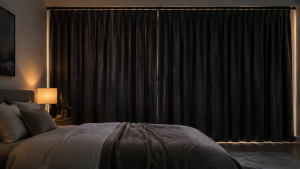
The non-negotiable is blackout curtains. Even if you live in a low-light area, streetlights or neighbor's outdoor lights can sneak in. I have a set of blackout fabric curtains that block 95% of outside light, and I also tuck them to the edges so they overlap in the middle. If you rent and can't change curtains, use a temporary but secure solution: blackout film on the window or a heavy shower curtain rod with a thermal curtain. Position the rod so the curtain extends at least six inches beyond the window frame on each side - this seals the gaps where light escapes.
When you wake up in the middle of the night to use the bathroom, don't flip on the overhead light. I keep a battery-operated dim amber light in the hallway that just barely illuminates the path. Your pupils have adapted to darkness, and a sudden bright blast will cut melatonin production for the rest of the night. The National Institutes of Health confirms that light exposure in the second half of the night disrupts circadian rhythms.
One common mistake is relying on the phone's dimming feature or a blue light filter app. Those help, but they don't eliminate the biological impact of light. I turned off all LED notifications on devices in the bedroom, and I cover the alarm clock with a cloth. It's not about being paranoid - it's about removing any light source that can pull your brain back to alertness.
Scent: Position Your Diffuser Where You Actually Breathe It
Smell is the most direct pathway to your limbic system, the emotional center of your brain. It bypasses rational thought and triggers autonomic responses like lowered heart rate or increased anxiety. That's why scent is a powerful tool for relaxation - but only if you position it correctly.
Most people set a scented candle on a dresser or plug in an air freshener near the door. That's ineffective. Your nose adapts to constant smells within minutes, so you stop noticing the lavender after a few minutes. To get a consistent effect, you need the scent to be present in the air you breathe as you're lying down, but not so strong that it overwhelms.
I use a ultrasonic diffuser placed on the nightstand, but not directly beside my head. The ideal spot is about three feet away, at a slightly lower height than your nostrils. The reason is that heavy essential oil particles settle downward, so if the diffuser is on the floor, the scent stays low. If it's on a high shelf, it dissipates upward. I learned this by trial and error when I put the diffuser on my headboard and ended up with a stuffy nose all night.
As for the scent itself, lavender is the classic for a reason. A 2015 meta-analysis in the Journal of Sleep Disorders and Therapy found that lavender improves sleep quality and increases slow-wave sleep. But not everyone responds to lavender. Some people find it too sweet or even slightly nauseating. Experiment with chamomile, cedarwood, or bergamot. I've found that a blend of lavender and cedarwood works better for me than lavender alone - the woodiness grounds the floral note.
Positioning also matters if you use a pillow spray or a scent diffusing pillow. Lightly spritz the pillowcase, not the pillow itself, because the moisture can seep into the pillow and cause mildew. I spray the pillowcase 30 minutes before bed, so the alcohol evaporates and the scent lingers. If you have pets, be careful with essential oils - some are toxic to cats and dogs. I keep my diffuser in a spot where my cat can't reach, and I only use pet-safe oils.
The controversial part: are essential oils actually effective or a placebo? A systematic review in Complementary Therapies in Clinical Practice suggests a modest effect, but the research is mixed. Don't rely on scent as your only sleep tool. Use it as a cue for your brain that bedtime is coming, just like brushing your teeth. The ritual of turning on the diffuser right before you get into bed can itself condition your mind for sleep.
Touch: The Tactile Swap That Signals Your Brain to Sleep
Your skin is your largest sensory organ, and the texture of your bedding sends powerful signals to your nervous system. Heavy duvets and rough flannel sheets might feel nice against your cheek, but they can trap heat and create friction that wakes you at 3 AM. The goal is to create a tactile environment that mimics the feeling of being held - without overheating.
Weighted blankets have become popular, and for good reason. They apply deep pressure stimulation, which increases serotonin and lowers cortisol. I was skeptical until I tried a 15-pound blanket. The change in my sleep latency was noticeable - I fell asleep about 20 minutes faster. But not everyone should use one: if you have asthma or circulatory issues, consult a doctor first. I keep the weighted blanket as a top layer, and I fold it at the foot of the bed during summer.
When it comes to sheets, stop obsessing over thread count. The fabric weave matters more. Percale is breathable and crisp; sateen feels smooth and silky but can trap heat. Linen is temperature-regulating but can be rough if not broken in. I now have two sets of sheets: a high-quality cotton percale for summer, and a brushed cotton for winter. The tactile variety tells your brain it's time to slow down.
Think about the texture of your mattress as well. A feather topper adds softness but can make you overheat. I use a wool mattress topper in winter and remove it for summer. The transition of textures as the seasons change also gives my body a different sensory signal - it's a literal reminder that sleep conditions have shifted.
Don't forget the floor. A fluffy rug next to the bed provides a soft landing for your feet in the morning, but it also absorbs sound and adds a cozy feel. If you have hardwood floors, a 4x6 wool rug under the bed (mostly covering the floor) is a game changer. I personally prefer a flat weave rug rather than a shag, because shag can trap dust and make allergies worse.
Temperature: The Hidden Factor That Dictates Bedroom Layout
Your core body temperature naturally drops about one to two degrees during sleep. If your bedroom is too warm or too cold, your body fights that drop. The optimal sleep temperature is around 65°F (18°C) for most people, but I've seen studies ranging from 60 to 67°F. The key is to create a microclimate in your sleep zone, not the whole room.
Here's where furniture placement matters more than you'd think. If you have a vent blowing directly on the bed, it can dry out your eyes and make you cold. I moved my bed away from the heating vent, and I angled the vent louvre so air circulates along the ceiling, not directly onto the mattress. In winter, I use a space heater only in the bathroom and hallway to pre-warm the room, but I turn it off before I sleep. In summer, instead of cranking the AC, I use a ceiling fan in a low-speed setting, position it so it creates a gentle crossflow without a direct draft. According to the CDC, keeping your bedroom at a comfortable temperature is one of the pillars of sleep hygiene.
Layering is the answer. I use a lightweight cotton sheet as a base, then a wool blanket, then a duvet with a breathable cotton cover. I can shed layers as the night warms up. This is better than one heavy comforter that can't be adjusted. A common mistake is buying a 12-pound comforter for year-round use. I've owned those, and they either bake you in spring or leave you shivering in fall.
Position your bed at least 30 inches from an exterior wall. Exterior walls are often colder in winter and warmer in summer. When I lived in an old house, the bed against a single-glazed window created a cold sink that chilled my shoulder. Moving the bed a foot away solved that. If you can't move the bed, place a fabric screen or a tall houseplant between the bed and the cold wall to create a buffer.
A Sample Sensory Layout: Step-by-Step Arrangement
Now let's put it all together. Here's a concrete layout that incorporates the 5-sense principles. Start with a clean room - empty the floor of clutter. Then follow these steps:
- Bed placement: Place the bed on the wall farthest from the door and any window that faces a noisy street. The headboard should be against a solid interior wall, not a wall shared with a bathroom or neighbor's hallway. If you must face a window, use a solid headboard that extends above your ears to block some noise.
- Sound blocking: Install a bookshelf or wardrobe against the wall that faces the street. Fill the lower shelves with heavy books or fabric bins. If you have a hollow wall, add a temporary acoustic panel - a 2x2 foam tile works - behind the headboard to dampen vibrations.
- Light layers: Replace your ceiling bulb with a dimmable warm LED. Install a blackout curtain rod, and use drapes that overlap. Add a small reading lamp on the nightstand, positioned so the shade blocks the bulb from your line of sight when you're lying down.
- Scent zone: Place a diffuser on a dresser or shelf about 3 to 5 feet from your pillow. Never on the floor. Alternatively, use a lavender lint roller on your pillowcase - a cheap hack I picked up from a hotel. Just roll the lint roller over the fabric and it picks up traces of the scent.
- Tactile layers: Start with a fitted sheet, then a top sheet, then a breathable duvet. Add a folded blanket at the foot of the bed - it's a visual cue plus a quick layer to pull up. Use pillowcases that feel smooth, not scratchy. Replace all polyester with cotton or bamboo.
- Temperature control: Position your bed away from direct HVAC vents. Use a digital thermometer to measure the temperature at your pillow height. If it's above 70°F, adjust your HVAC or use a small room fan (but not directly on your face). Keep the bedroom door open two inches to allow air circulation.
This layout is not a strict prescription - it's a framework. Adjust it to your room's constraints. For example, if your bed has to be next to a window, you can still add blackout curtains and a thick Roman shade to cover the gap. The point is to systematically address each sense on the list.
What Goes Wrong and How to Fix It (The Real-World Trade-offs)
No anatomical solution is foolproof. I've made many mistakes, and the fix often comes with a downside. Here are the trade-offs you should expect.
White noise machines can be too loud. I set mine to 70 dB once, and I woke up with a headache. The correct level is around 50 dB - just loud enough to mask the traffic but not make your ears ring. Also, some people habituate to white noise after a few weeks and need to increase the volume. Instead of turning it up, change the sound frequency or switch to a brown noise variant.
Blackout curtains can make your bedroom coffin-like. I felt disoriented for the first few days because I couldn't tell if it was dawn. Solution: install a low-wattage orange LED strip under the bed to act as a nightlight that doesn't disrupt melatonin. Or set a timer to turn on the bedroom lamp before your alarm.
Essential oils can trigger allergies or asthma. I once used eucalyptus oil, and my sinuses swelled. Start with a tiny amount, and test for 15 minutes during the day. If you have any respiratory condition, consult an allergist before using aromatherapy at night.
Heavy blankets can cause night sweats. Even a 10-pound blanket can make you sweat if your room is too warm. I switched to a cooling gel mattress pad under my fitted sheet, which wicks heat away. Also, keep your feet uncovered - they help regulate temperature.
Furniture rearrangement can make the room feel cramped. I moved my bed away from the vent and suddenly had an awkward L-shaped layout. To compensate, I removed a bulky wardrobe and used open shelving. You don't need to fit everything - you need a functional path to the bed. The bed should be the visual and physical center of the room, not an afterthought.
Remember that sleep needs change as you age, with seasons, and with your stress levels. I regularly reassess my bedroom every six months. What worked in June might not work in December. Keep your 5-sense audit in mind, and you'll be able to adjust quickly.
For a deeper dive into the basics of layout and how to avoid common mistakes, check out my guide on Bedroom Arrangement Tips for Restful Nights. And if you're looking for quick wins tonight, see the 5 Bedroom Tweaks for Immediate Sleep Gains. But remember: the sensory audit is the foundation. Arrange for your ears, your nose, your skin, and your thermoregulation, and the visual side will naturally fall into place.